> ## Documentation Index
> Fetch the complete documentation index at: https://docs.worldassetregister.com/llms.txt
> Use this file to discover all available pages before exploring further.
# Roles and permissions
> Who can see and do what
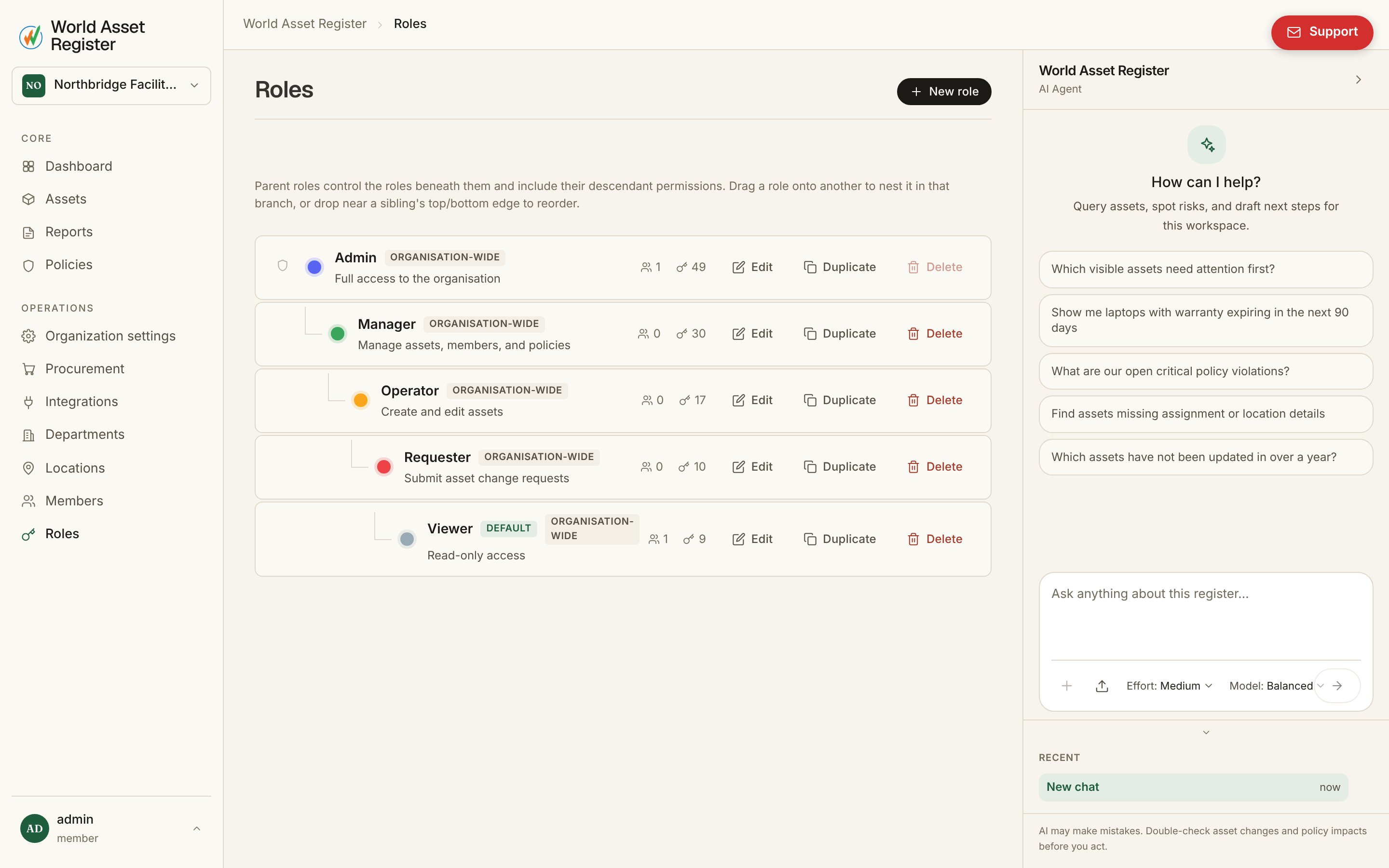
Access is role based. Every member holds one or more roles, every role is
a set of permissions, and every screen and action in the product checks
them. Manage roles from **Roles** in the sidebar.
 ## Built-in roles
An **Admin** role that can do everything ships by default and can't be
deleted, alongside a starting set covering common needs: a viewer, an
editor, and similar. Most organisations extend this set rather than
replace it.
## Creating a custom role
Open **Roles → New role** for the full editor:
## Built-in roles
An **Admin** role that can do everything ships by default and can't be
deleted, alongside a starting set covering common needs: a viewer, an
editor, and similar. Most organisations extend this set rather than
replace it.
## Creating a custom role
Open **Roles → New role** for the full editor:
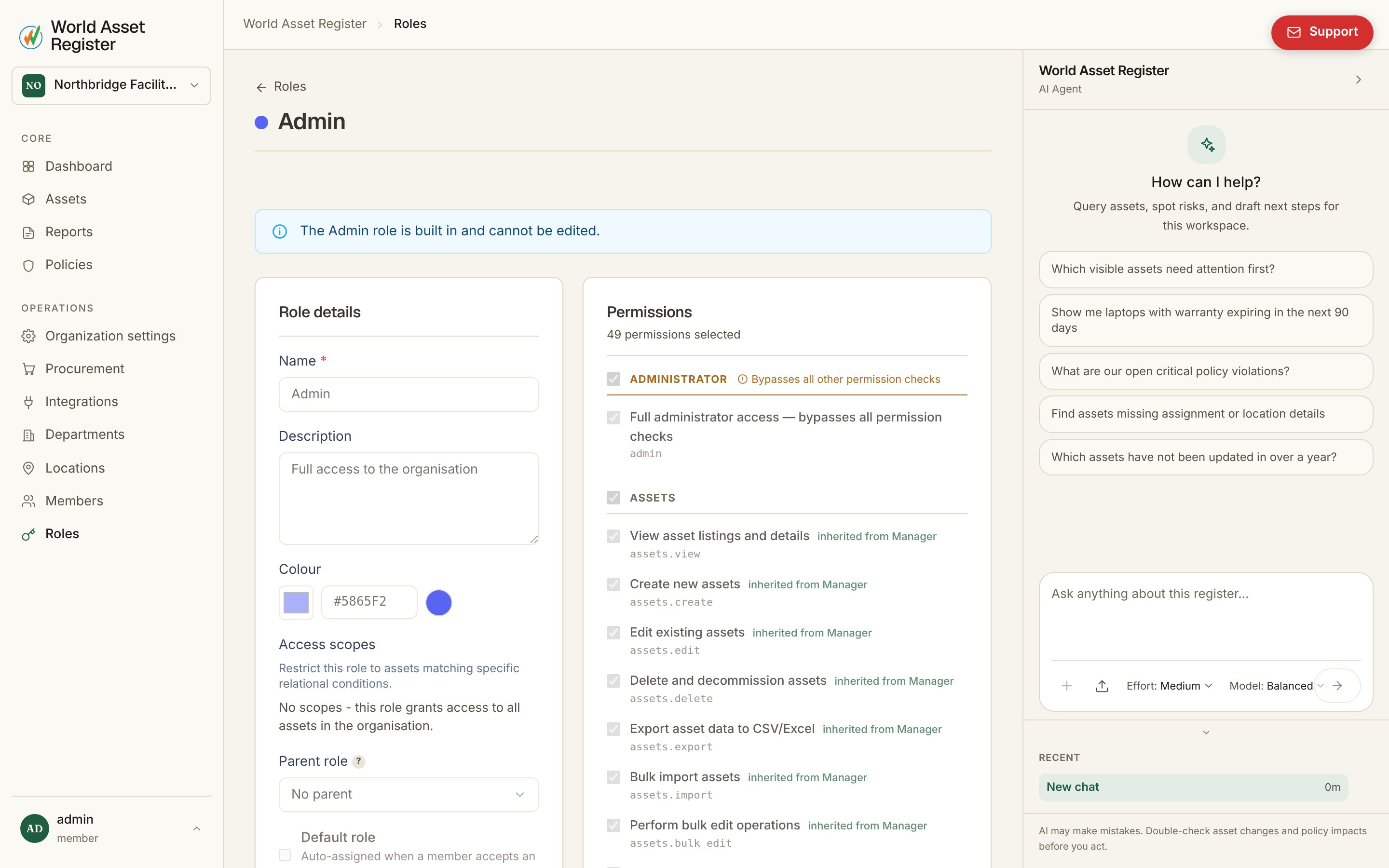 * **Colour**: shown next to the role wherever it appears, so members can
be told apart at a glance in busy lists.
* **Permissions**: a categorised catalog (assets, members, policies,
reports, billing, and more). Check what this role can do.
* **Field access**: per-field control on assets. **Read**, **Request**,
or **Write**. *Request* is what powers
[change requests](/assets/change-requests). The role can propose a
change to that field without being able to save it directly.
* **Access scopes**: restrict the role to assets matching a condition
(say, only assets at a specific location or in a specific category).
Useful for regional managers or contractors who should only see their
own patch.
* **Parent role**: an optional delegation chain. This role automatically
gains everything its parent grants, on top of its own permissions.
Build a "Senior editor" once, then set junior roles to inherit from it
instead of re-ticking every permission.
* **Default role**: the role automatically given to anyone who accepts an
invitation with no role specified.
## Choosing what to build
A few patterns cover most organisations:
* **Viewer**: read everything, write nothing. Good for auditors and
stakeholders who need visibility without risk.
* **Custodian or site manager**: write access scoped to their own
location or department via access scopes, so they can manage what's
theirs without touching anyone else's.
* **Contractor**: narrow permissions, request-only field access, and an
access scope limited to the assets they're actually engaged on.
## Field-level control in practice
Field access is where roles and [change requests](/assets/change-requests)
meet. Mark cost fields *Request* for a site manager role and *Write* for
finance, and site managers can flag a cost correction that finance signs
off on, without ever being able to change the number themselves.
* **Colour**: shown next to the role wherever it appears, so members can
be told apart at a glance in busy lists.
* **Permissions**: a categorised catalog (assets, members, policies,
reports, billing, and more). Check what this role can do.
* **Field access**: per-field control on assets. **Read**, **Request**,
or **Write**. *Request* is what powers
[change requests](/assets/change-requests). The role can propose a
change to that field without being able to save it directly.
* **Access scopes**: restrict the role to assets matching a condition
(say, only assets at a specific location or in a specific category).
Useful for regional managers or contractors who should only see their
own patch.
* **Parent role**: an optional delegation chain. This role automatically
gains everything its parent grants, on top of its own permissions.
Build a "Senior editor" once, then set junior roles to inherit from it
instead of re-ticking every permission.
* **Default role**: the role automatically given to anyone who accepts an
invitation with no role specified.
## Choosing what to build
A few patterns cover most organisations:
* **Viewer**: read everything, write nothing. Good for auditors and
stakeholders who need visibility without risk.
* **Custodian or site manager**: write access scoped to their own
location or department via access scopes, so they can manage what's
theirs without touching anyone else's.
* **Contractor**: narrow permissions, request-only field access, and an
access scope limited to the assets they're actually engaged on.
## Field-level control in practice
Field access is where roles and [change requests](/assets/change-requests)
meet. Mark cost fields *Request* for a site manager role and *Write* for
finance, and site managers can flag a cost correction that finance signs
off on, without ever being able to change the number themselves.